In this Document
The Problem:
Finding the Risk Is Not the Same as Reducing It
The two clocks of taking action


What Gartner analysts say
"As attackers use advanced AI to find and exploit vulnerabilities faster than organizations can patch them, prioritizing exposures based solely on inferred risk is no longer enough. Product leaders must adopt preemptive exposure management, using AI-driven validation to prove evidence of exploitability and autonomous interdiction to neutralize attack paths, delivering measurable, real-time risk reduction."
What the data says

The standards already endorse mitigation
Case Study:
React2Shell (CVE-2025-55182)
Timeline:
Real customer outcome with Miggo Security Autonomous Mitigation:
Time to verified mitigation:
Time to remediation:
Security Outcomes of Autonomous Mitigation

From
To
The test is simple: did the security state change so the exploit path can nolonger succeed and can you prove it?
Autonomous Mitigation and virtual patching
Case Study:
Beat the Bypass
Best-performing generic managed ruleset

Real Exploit Bypasses Blocked
What can Autonomous Mitigation do?

The Autonomous Mitigation Loop
Know the live environment
Establish existing reachability, behavior, dependencies, legitimate traffic, and available enforcement points.
Prove exploitability in the attack path
Confirm that the exact attack path works in real time. Severity, presence, or theoretical reachability alone does not provide strong enough proof.
Choose the optimal action
Reason across mitigation techniques and control points to select the most effective change, with the smallest impact, within an understood blast radius.
Deploy the mitigation
Deploy protection at machine speed, within policy and approval boundaries, with auditability and rollback.
Verify and adapt to environment
Re-run the attack, test bypass variants, protect legitimate behavior, and revalidate as the application, controls, and threat evolve.
Govern and improve
Monitor exposure and architectural drifts, identify new threat intelligence to reevaluate mitigation, and improve ongoing capabilities to preempt future exploitability.
Retire
Monitor if the vulnerability is still there or if remediation has occurred, and retire the rule when unnecessary.
Where Autonomous Mitigation sits in the ecosystem
The category standard
What does NOT qualify as Autonomous Mitigation

Find &prioritize
Validate exploitability
Generateone-time output
Generic automation playbook
How to Measure the Efficacy of Mitigation
Time to Verified Mitigation (TTVM): the North Starmetric for zero exploitability
program performs on a typical vulnerability. The tail shows how long the worst windows stay open, and the tail is where breaches happen.
TTVM breakdown
The Autonomous Mitigation scorecard
should be measured on six outcomes:
TTVM
Mitigation coverage
Adversarial efficacy
Operational safety
deployed mitigations (false-positive
rate)
Resilience
Autonomy rate
4 (see below)
The Path to Autonomous Mitigation
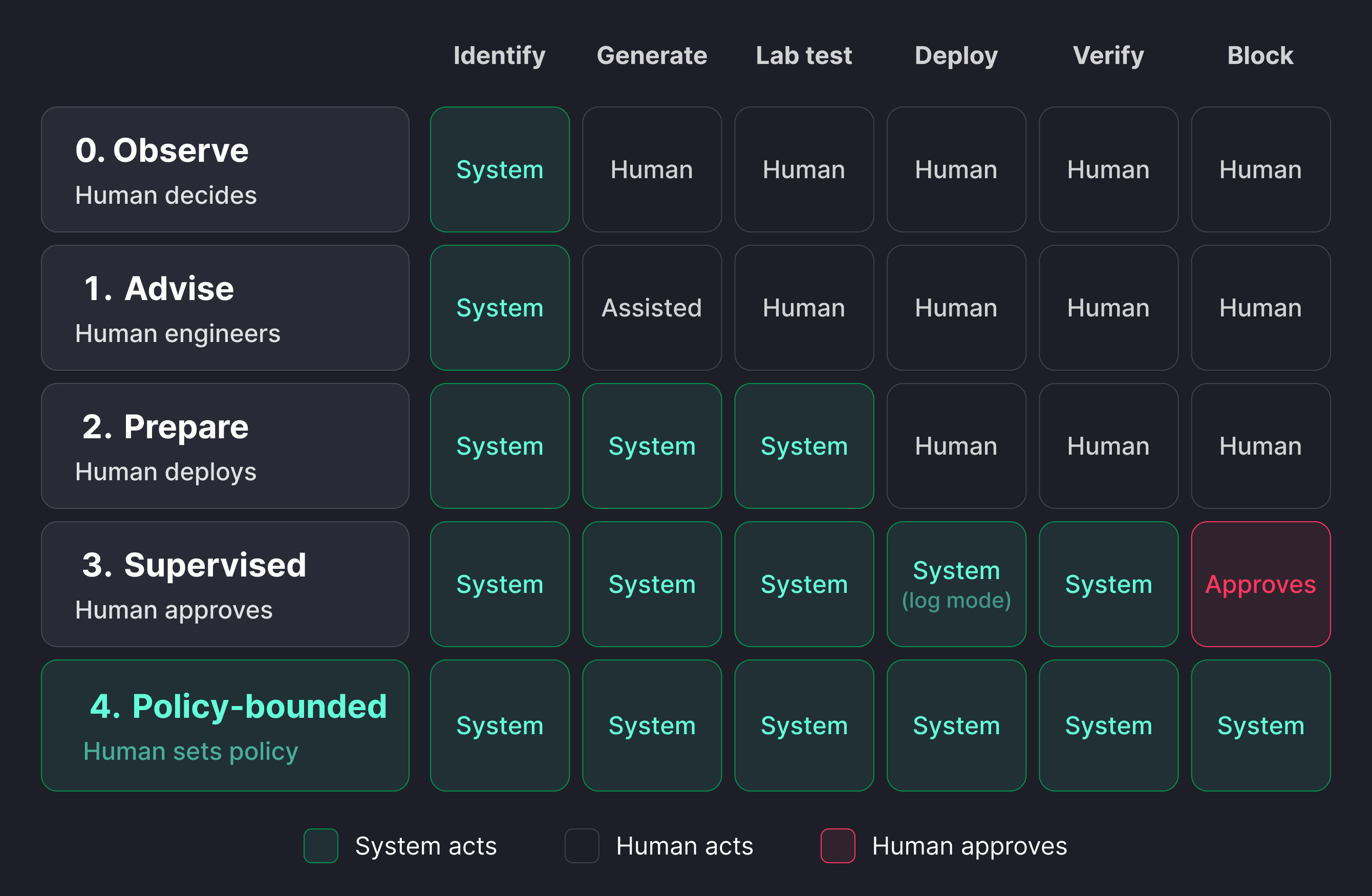
Does your organization's security program need Autonomous Mitigation capabilities?
Assess your window:
Achieving Zero Exploitability withMiggo Security
Whitepaper
Get the whitepaper
Closing the Exploitability Window