TL;DR
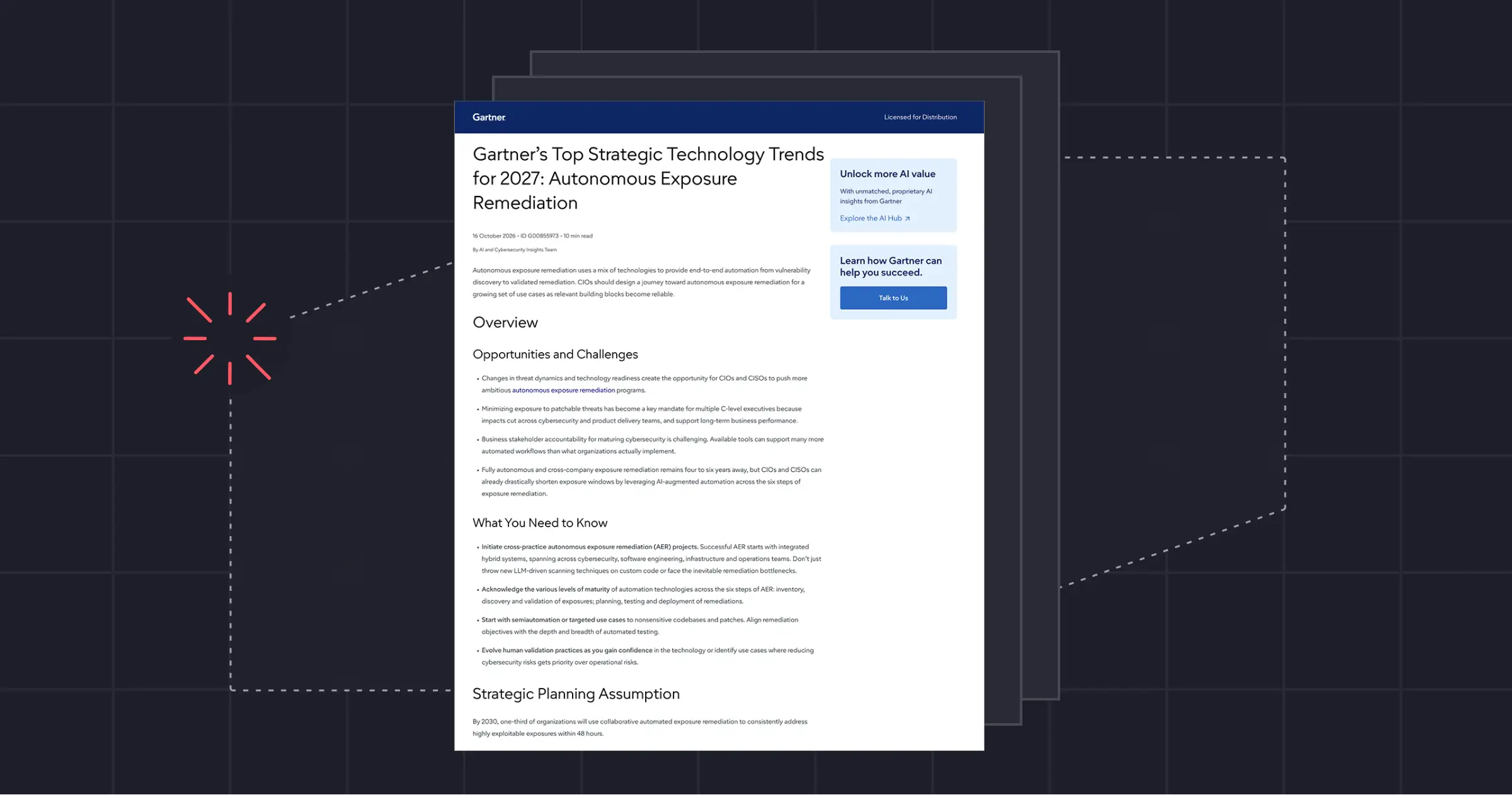
Gartner® has named Autonomous Exposure Remediation (AER) one of its Top Strategic Technology Trends for 2027. The report discusses six steps from inventory to deployed fix, places fully autonomous remediation four to six years out, and points to virtual patching as one of the main ways AER will extend to third-party software and infrastructure. Miggo is named as a Sample Vendor. This post walks through our understanding of the report and shows where we feel Autonomous Mitigation fits on the road to AER.
Attackers have always exploited vulnerabilities faster than organizations could patch them. What has changed is how many attackers can now do it. In our view, Gartner points out that agentic automation opens semiautomated postbreach activities to "a growing number of less sophisticated threat actors," while frontier models keep getting better at scanning source code and producing proofs of concept. The window between disclosure and exploitation is closing faster than remediation workflows can respond.
The Gartner insights say Autonomous Exposure Remediation "uses a mix of technologies to provide end-to-end automation from vulnerability discovery to validated remediation."
AI-powered discovery has not made remediation any harder. It has exposed how much more there is to fix. Fifty-three percent of cybersecurity leaders already report noticeable improvements in security metrics from using generative AI to scan application code, yet remediation still moves at human pace. Gartner warns that scanning without matching automation downstream inflates the application team's queue of fixes rather than shrinking the exposure window.
The report states a Strategic Planning Assumption: "By 2030, one-third of organizations will use collaborative automated exposure remediation to consistently address highly exploitable exposures within 48 hours."
Miggo is named as a Sample Vendor for AER. Our Autonomous Mitigation approach was built for the gap this report describes.
What Goes into AER?
"The foundation of AER is strong exposure prioritization, including ways to validate the existence and impact of a patchable exposure through adversarial testing and cyberthreat intelligence. Its core component is automated test generation and validation, which build trust into remediation and deployment stability."
Validation happens at both ends of the workflow. At the start, it confirms that an exposure is real and critical. At the end, it confirms that the fix works. Automation carries everything in between. Gartner discusses AER in six steps:
- Inventory. Accurate, real-time visibility of exposed assets.
- Discovery. Using version information, custom code scans and configuration analysis to surface vulnerabilities.
- Issue validation. Confirming that an exposure is real and critical, passively through exploitability and reachability, and actively through adversarial exposure validation.
- Planning. Proposing remediation options, assessing dependencies and side effects, and scoring operational risk.
- Fix verification. Testing that a patch or virtual patch works, including against exploit variants, and suggesting telemetry to monitor.
- Remediation. Deploying the fix, monitoring the affected systems and rolling back if necessary.
Gartner notes that most technologies stop after planning today, and that the last two steps are still on vendors' roadmaps. We feel Miggo covers validation directly and handles the time pressure through mitigation: when a fix cannot ship in time, Autonomous Mitigation blocks the exploit path until it can.
What Does AER Look Like Today?
To us, Gartner is candid that full AER is not here yet.
"Available tools can support many more automated workflows than what organizations actually implement. Fully autonomous and cross-company exposure remediation remains four to six years away, but CIOs and CISOs can already drastically shorten exposure windows by leveraging AI-augmented automation across the six steps of exposure remediation."
The distance is not a matter of model quality alone. A permanent fix touches code, dependencies, performance, availability and rollback, and each of those has to be tested before anyone will let a machine push the change to production. Gartner notes that existing technologies "don't yet provide sufficient trust to update critical infrastructure automatically," and that getting there requires comprehensive testing and simulation, high-availability infrastructure, automated rollback and a shift in the organization's risk tolerance.
Gartner names four challenges holding adoption back:
- Fragmentation. AER technologies are fragmented in scope and use case and are mostly limited to custom code, third-party code and web applications.
- Trust. Organizations are not yet ready to let automation update critical systems.
- Scanning without remediation. LLM-driven scanning of custom code is gaining disproportionate momentum and is growing the fix queue.
- Cost. Frontier model costs for analysis, fix suggestions and test generation are high and unpredictable.
What Gartner Recommends
In our view, the Gartner insight is incremental. We feel it favors building trust step by step and designing for AER now, rather than waiting for full autonomy.
- Start with a narrow scope and nonsensitive custom code, and expand as test, deployment and rollback automation matures.
- Tier automation objectives by exploitability, reachability and the maturity of automation for each use case.
- Update prioritization and remediation practices so that automated discovery does not create a choke point.
- Analyze costs early.
- Align security automation with the pace of application development, including agentic development loops.
- Design future architecture to natively support AER.
Inside the Autonomous Mitigation Loop
Autonomous Mitigation runs as a continuous loop between exposure detection and permanent remediation. Each pass through the loop includes these things:
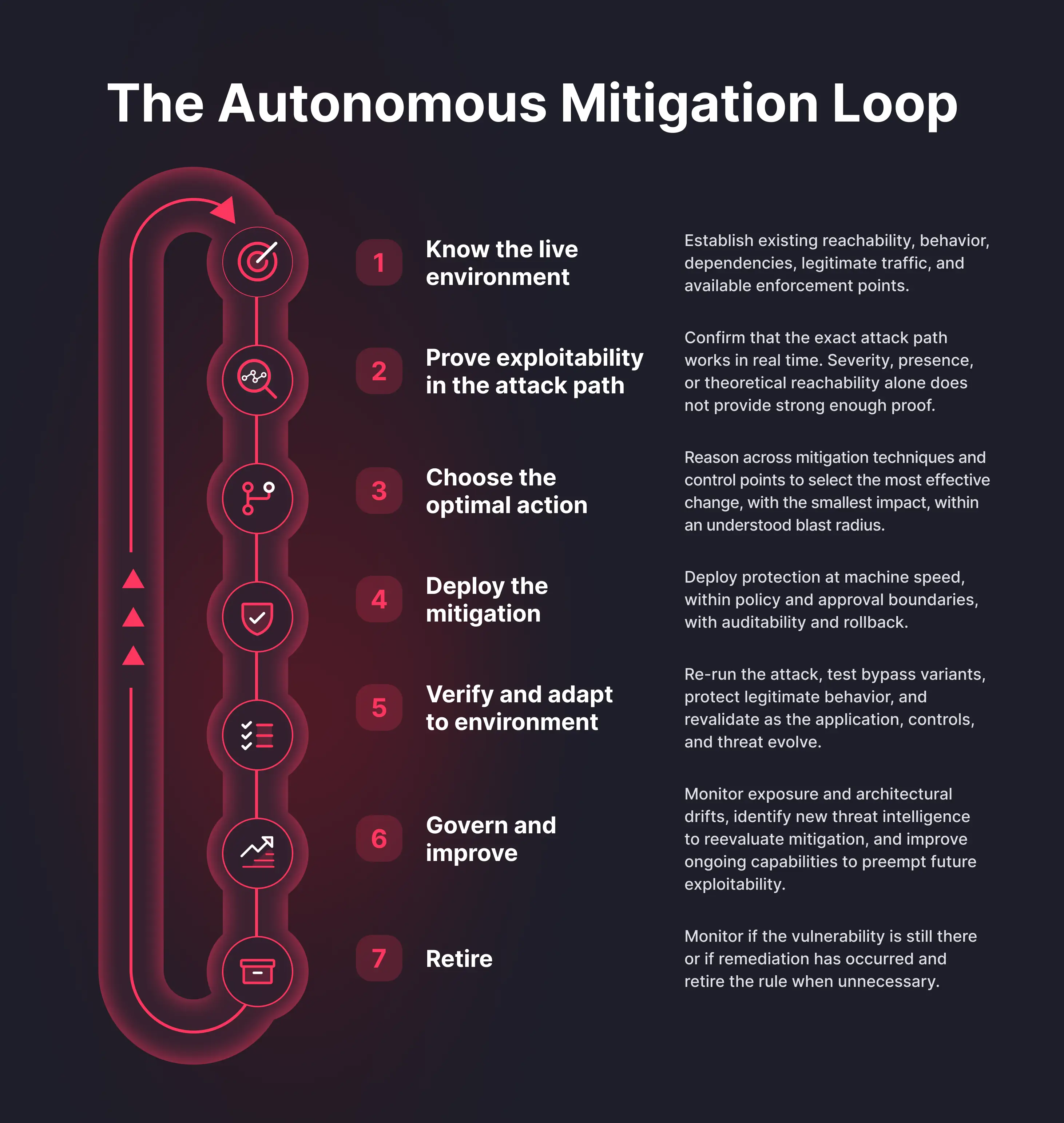
- Validate. Prove whether the vulnerability is reachable, exposed and exploitable in your environment.
- Select. Choose the mitigating action best suited to the exploit path.
- Mitigate. Deploy the mitigation without a code change or a release cycle.
- Verify. Confirm that the exploit path is closed, including against bypasses. In Miggo's Beat the Bypass research, Miggo WAF Copilot blocked 91% of real exploit bypasses, compared with 48% for the best generic managed ruleset.
- Hold. Keep operations running and the mitigation in place until the permanent fix ships, then retire it.
The loop runs within human-set policy bounds, following a framework borrowed from self-driving cars, and gains autonomy one capability at a time as trust builds. The Autonomous Mitigation whitepaper covers each stage in detail.
The Gartner planning assumption sets a 48-hour target for highly exploitable exposures by 2030. The loop closes the exploit path in minutes today, so that teams can mitigate now and patch when they are ready.
Read the full Gartner research. Get Gartner’s Top Strategic Technology Trends for 2027: Autonomous Exposure Remediation >>>
Key takeaways
Frequently Asked Questions
Heading